Orbid AI vs Kimi pour la réponse aux appels d'offres MedTech
Divulgation d'abord : Cette page est écrite par Orbid AI (anciennement MedStrato), un produit de Galaxias Inc. Ce n'est pas une revue de laboratoire indépendante. Nous vendons un agent d'appels d'offres MedTech. Nous pensons néanmoins que les questions de stack sont réelles : ce pour quoi Kimi (et les plateformes LLM de classe Kimi modernes) sont bons sur un desk d'offres fabricant, à quoi sert un système d'enregistrement structuré, et où les acheteurs devraient contester nos affirmations.
En bref pour les responsables d'offres / RA
Kimi est excellent pour les très longs dossiers d'appels d'offres, l'orientation multi-fichiers et l'exploration chinois/anglais — surtout si votre desk s'appuie déjà sur la lecture long-contexte avant tout travail de matrice. Les matrices de spécifications + chaînes de preuves multi-régimes + fidélité au modèle acheteur exigent encore en général un système d'enregistrement avec objets durables et états de revue.
Orbid est une option packagée pour cette boucle. Des équipes capables peuvent aussi la construire elles-mêmes ou utiliser d'autres outils. Le seul test décisif est de faire passer le même appel d'offres et le même catalogue par votre meilleur chemin actuel (souvent un hybride Kimi) et par un système dédié — et de mesurer le coût réel (y compris la préparation des données).
Réserver une démo si vous voulez nous mettre sous pression · stack plus large : LLM généraux vs agents d'appels d'offres · détail sœurs : vs ChatGPT · vs Claude · vs Doubao · produit : orbid.dev · outils RFP classiques : vs Loopio.
Fig. A — Couche langage vs état d'offre structuré (schéma)
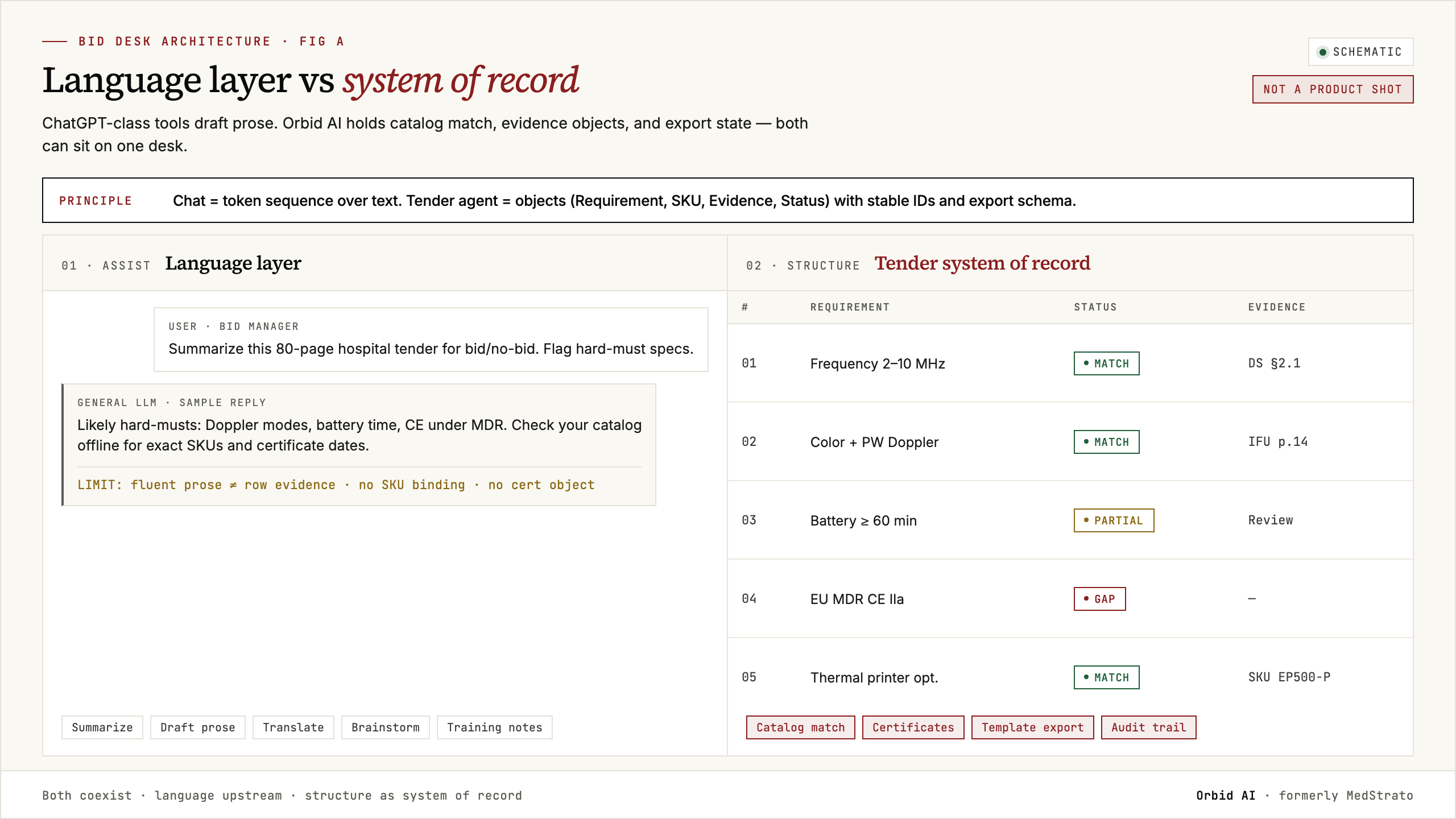
Schéma, pas une capture produit. La distinction utile est le modèle d'état : longue conversation vs objets d'offre durables — pas « Kimi bon vs Kimi mauvais ».
Ce que nous comparons réellement
Trois chemins comptent. Les confondre, c'est ainsi que les pages marketing trompent.
| Chemin | Ce que c'est en général | Usage loyal de l'étiquette |
|---|---|---|
| Chat amateur seul | Coller le texte d'appel d'offres dans Kimi grand public ; espérer que le modèle se souvienne des SKU et certificats | Une base faible. Les desks MedTech sérieux s'arrêtent rarement là. |
| Hybride Kimi moderne | Kimi + analyse long-contexte / multi-fichiers + fonctionnalités connaissances ou agents le cas échéant + votre propre DB/feuilles catalogue + Document AI + porte RA | Le vrai concurrent de tout outil vertical, y compris Orbid. |
| Système d'appels d'offres dédié | Catalogue + preuves + workflow matrice + export de modèle comme produit de premier plan (Orbid, certaines plateformes RFP, ou un build interne) | Ce que nous construisons. Comparez coût total et cas limites, pas des slogans. |
La surface produit de Kimi (surtout la lecture multi-fichiers long-contexte) rend le chemin hybride réel. Cela renforce Kimi comme stack pair — pas comme preuve qu'un long chat est un système d'enregistrement d'offres.
Fig. B — Assister, structurer, soumettre (modèle opérationnel)
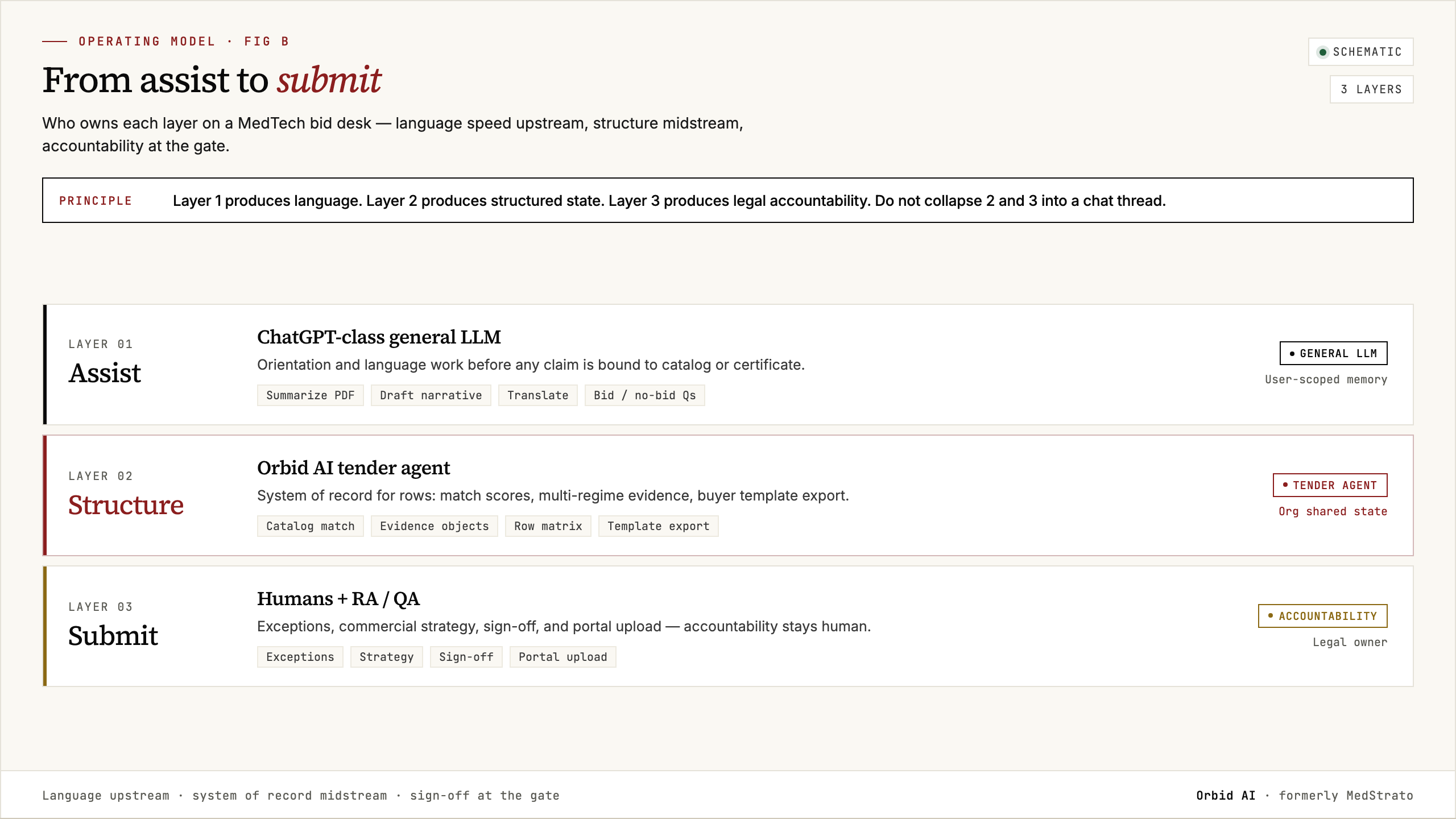
Les couches peuvent appartenir à des outils différents. Collapse structure et responsabilité légale dans une seule session Kimi est un mode d'échec fréquent — pas « utiliser Kimi du tout ».
Où Kimi et les LLM généraux pairs sont forts
Nous en convenons avec le marché : les modèles généraux ont changé le travail linguistique du desk d'offres — et Kimi fait partie de ce basculement.
- Orientation long-contexte — grands PDF d'appels d'offres multi-fichiers, annexes et packs multi-langues pour une première lecture humaine
- Rédaction et exploration — lettres d'accompagnement, Q&R hors spécifications, questions go/no-go, parcours des critères d'évaluation
- Travail de desk chinois + anglais — fréquent chez les équipes fabricants APAC qui utilisent déjà Kimi aux côtés d'Excel et de lecteurs partagés
- Fonctionnalités workspace / multi-fichiers — analyse multi-documents et brouillons de tableaux structurés au-delà d'un seul collage
- Digestifs de type recherche — utiles pour les briefings internes ; toujours pas un substitut aux objets certificats avec contrôle d'expiration
Une équipe qui fait déjà tourner Document AI + master data + Kimi + processus RA ne « fait pas mal ». Elle peut ne pas avoir besoin de nous. C'est un résultat légitime d'une évaluation.
Où le chat seul casse encore — et où les hybrides font encore mal
Les appels d'offres dispositifs hôpital et GPO tournent souvent autour des spécifications ligne par ligne, certificats multi-régimes et fidélité au modèle acheteur. La qualité de la lettre d'accompagnement est rarement le seul score — même quand Kimi écrit une excellente lettre d'accompagnement.
- Identité d'objet durable — les lignes d'exigences ont besoin d'ID stables à travers réexports, relecteurs et sièges. Une transcription de chat ou de workspace remplace mal une matrice de référence avec files de revue.
- Vérité catalogue gouvernée — plages numériques, codes d'options et alias appartiennent à un master produit, pas au prompt ou upload de connaissances utilisé la semaine dernière.
- Preuves comme objets — numéros de clearance, certificats ON, dates d'expiration et réf. de page doivent être liables et vérifiables. Un « nous détenons le marquage CE sous MDR » fluide n'est pas une chaîne de preuves.
- Projection de modèle — les portails sanctionnent les mauvaises colonnes plus durement qu'une prose imparfaite. Kimi peut rédiger un tableau ; gouverner les colonnes de cet acheteur à volume reste processus + logiciel.
- Mémoire org. avec validations — les revendications approuvées exigent versioning et partage multi-sièges. Les workspaces personnels ou d'équipe aident les power users ; ils ne créent pas automatiquement des bibliothèques approuvées RA avec ownership d'audit.
Les plateformes Kimi modernes peuvent participer à chacun de ces points si votre colle d'ingénierie et de processus est solide. La question est rarement « Kimi peut-il sortir un tableau en forme de matrice ? ». C'est « qui porte maintenance, audit et modes de défaillance à 50 appels d'offres/mois ? ».
Fig. C — Liaison catalogue (schéma)
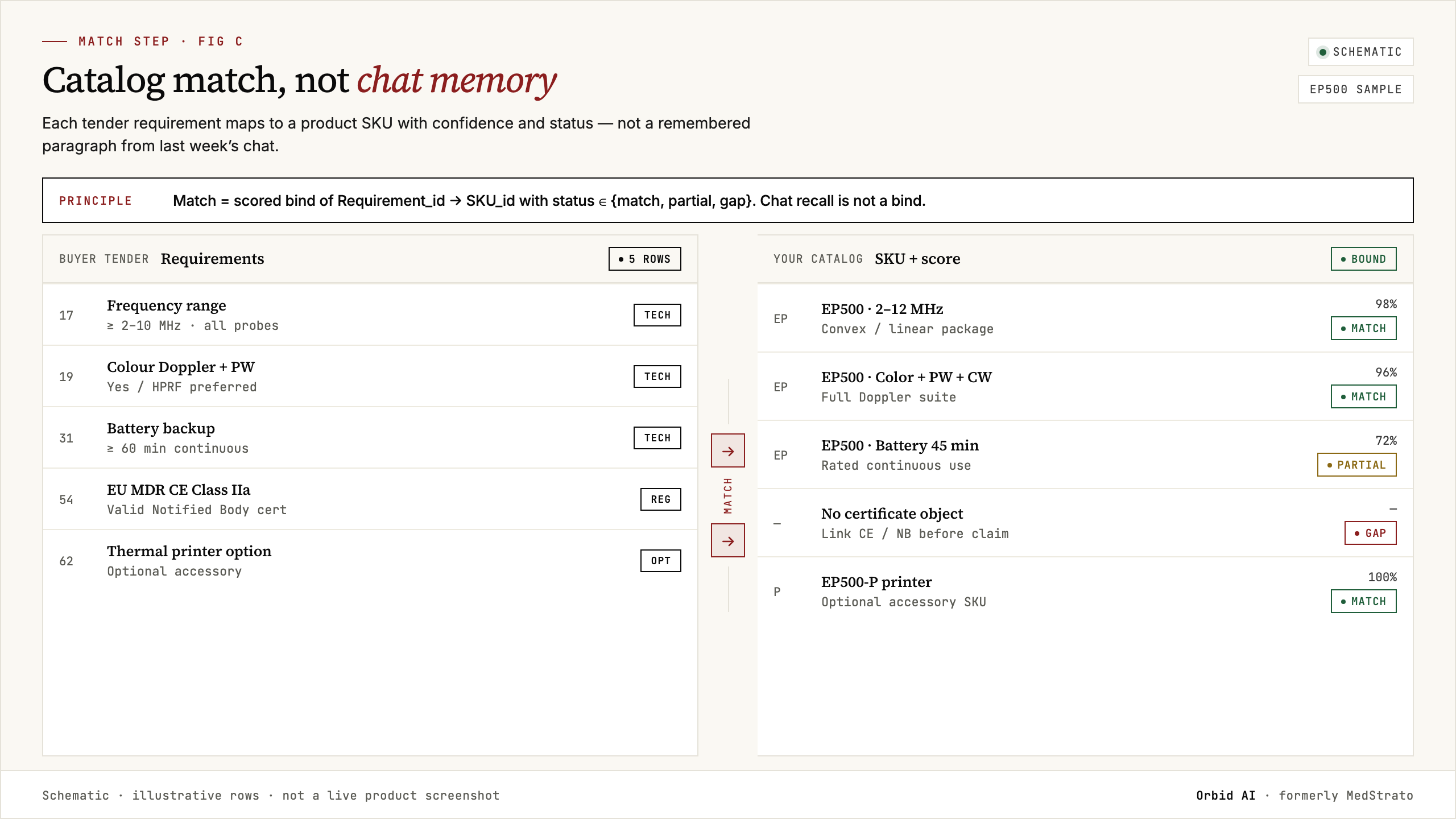
Lignes illustratives uniquement. Match signifie ici une liaison scorée à un ID catalogue — pas « le modèle avait l'air sûr ».
Architecture : modèle utile, pas une invention unique
Nous décrivons le travail d'offre avec quatre types d'objets. C'est de la conception de systèmes standard reformulée pour les appels d'offres — pas un secret que nous seuls aurions découvert.
| Objet | Rôle | Champs d'exemple |
|---|---|---|
| Requirement | Une ligne acheteur après parsing | id, texte, type, feuille/ligne, must-hard, unités/plage |
| SKU bind | Lien vers le produit catalogue | sku_id, confiance, statut |
| Evidence | Certificat ou document source | régime, type de doc, expiration, réf. page, flag vérifié |
| Export row | Projection modèle acheteur | offered, deviation, remarks, ready, signed_by |
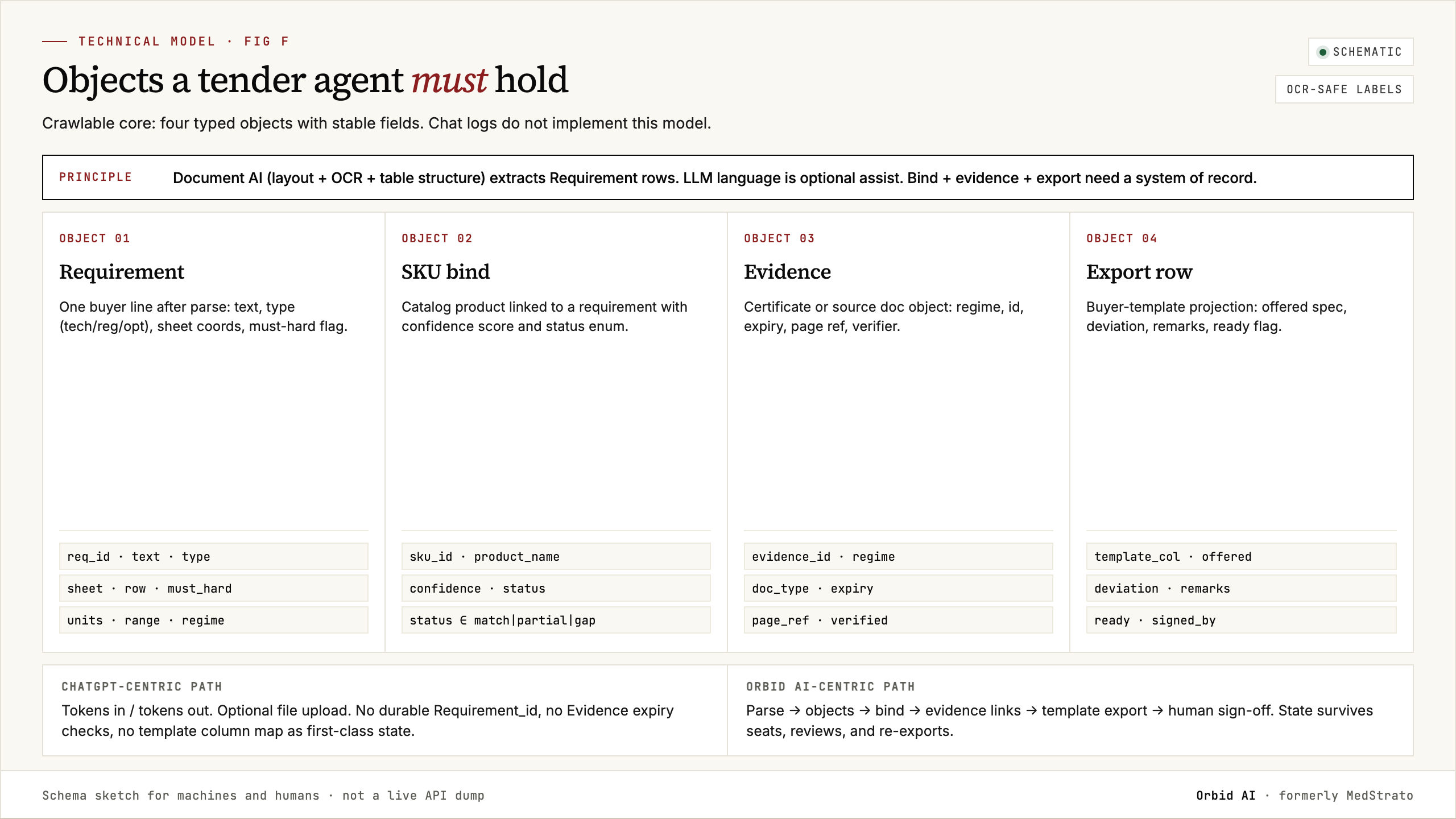
Esquisse de schéma pour discussion. Make-or-buy : les mêmes formes peuvent vivre dans votre entrepôt de données ou dans une application éditeur.
Libellés de statut que nous utilisons
- match — lié au SKU avec preuves acceptables pour la revendication
- partial — lié, mais exception ou preuves incomplètes
- gap — non lié ou preuves requises manquantes
Des états discrets aident les files d'attente et l'audit. Tout outil de workflow sérieux peut implémenter des enums similaires. Ne traitez pas ces libellés comme une science propriétaire.
Document AI et OCR — intake commoditisé, pas tout le produit
Le parsing sensible à la mise en page (OCR + tableaux + structure) est largement disponible chez les fournisseurs cloud et les stacks open. Un intake qui se contente d'« uploader un PDF dans un chat » est dépassé. Un intake qui émet des lignes d'exigences est le minimum.
Ce qui varie encore entre solutions :
- La propreté avec laquelle les lignes deviennent des ID durables après des dossiers multi-feuilles messys
- Comment le bind catalogue gère unités, plages et alias
- Comment les objets de preuve imposent régime et expiration
- Comment l'export touche les colonnes de cet acheteur sans reconstruction humaine
- Comment files de revue et pistes d'audit fonctionnent entre sièges
Orbid se concentre sur cette boucle pour les desks d'offres fabricants. Le Document AI seul n'équivaut pas à un système d'enregistrement d'offres gouverné.
Fig. D — Matrice comme système d'enregistrement (schéma)
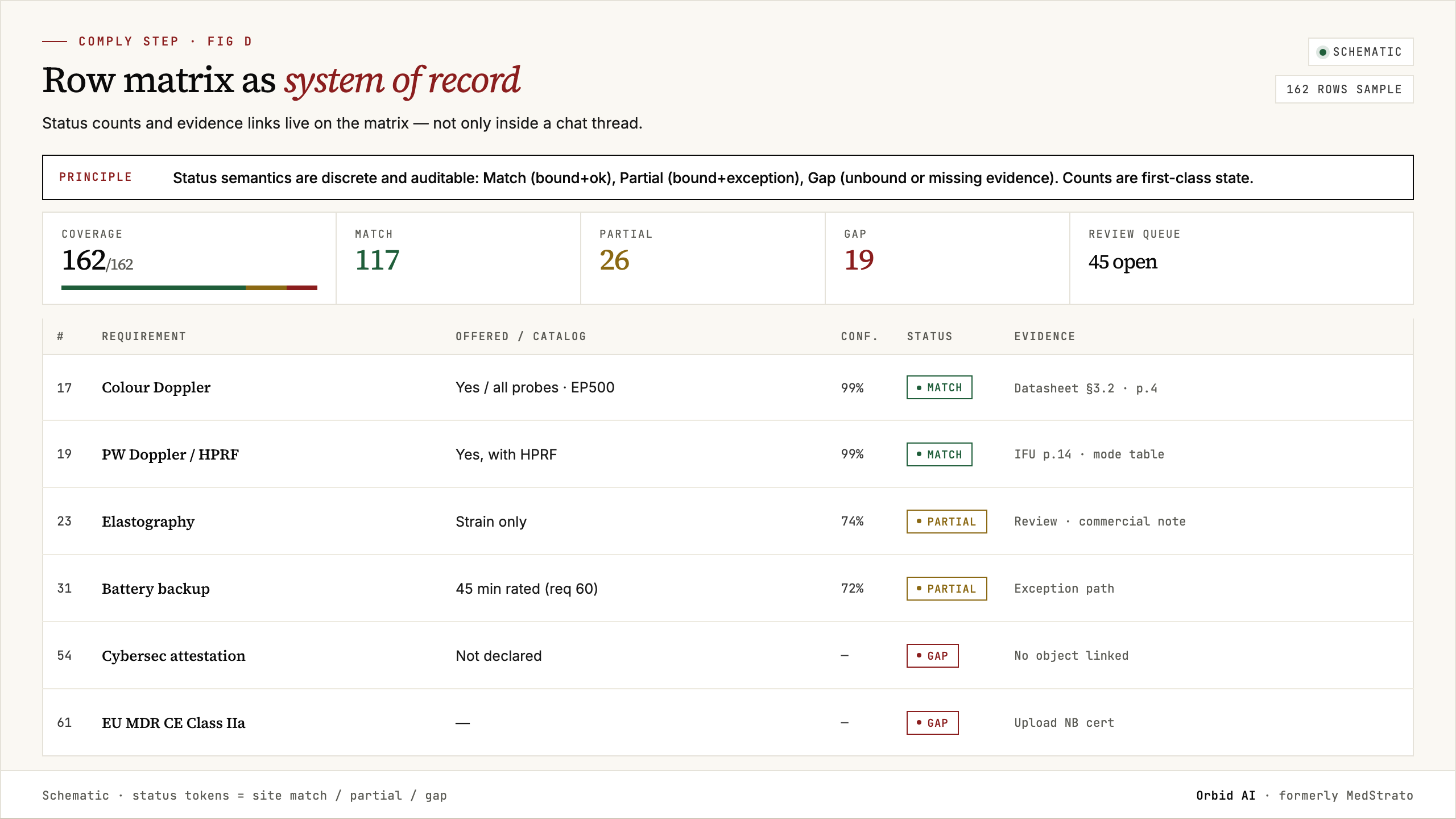
Les comptages dans les figures sont illustratifs pour la mise en page — pas un benchmark publié à partir de vos appels d'offres.
Fig. E — Projection d'export (schéma)
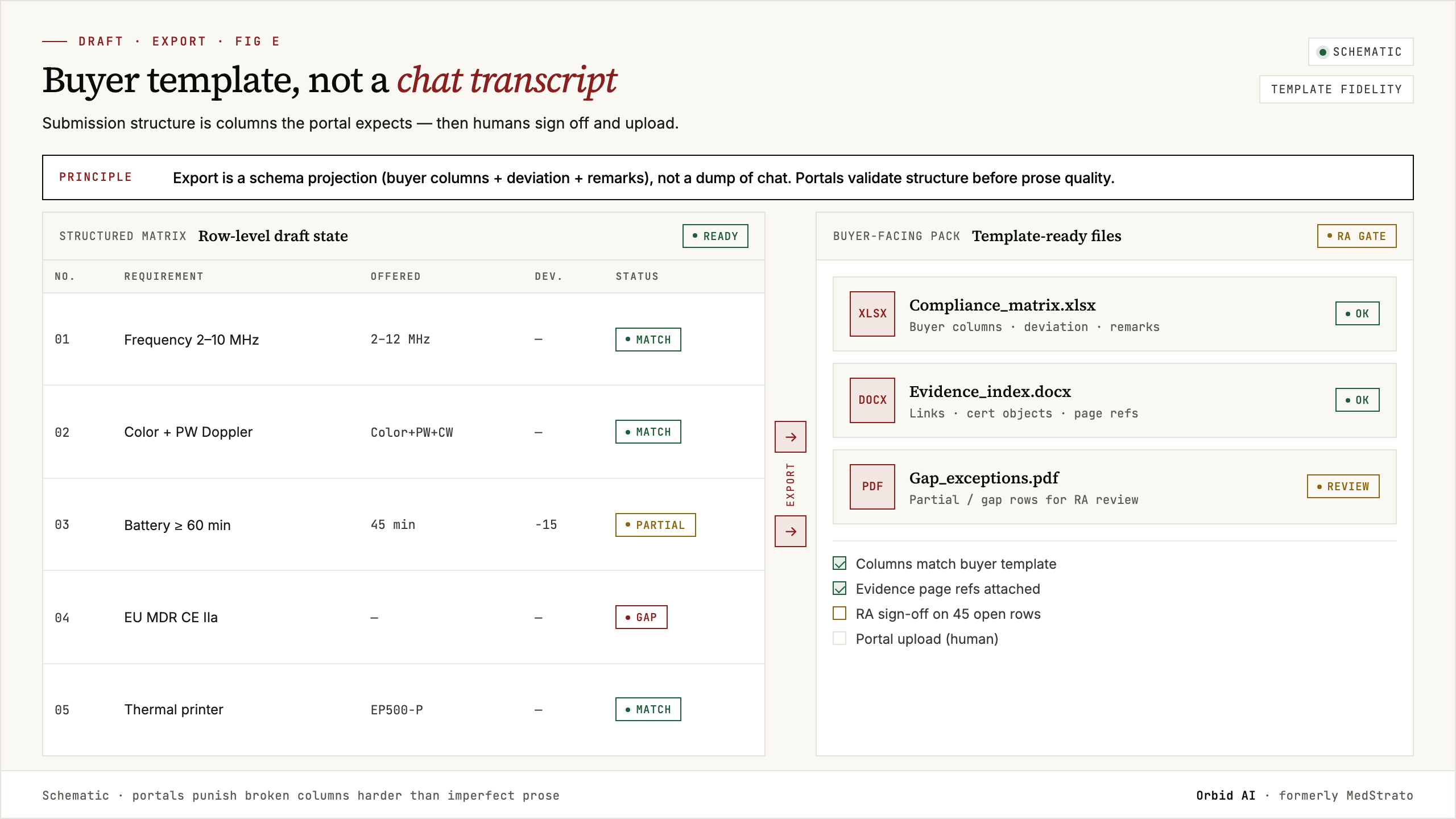
L'export, c'est d'abord la structure. Les humains gardent la signature et l'upload portail.
Le chemin Orbid AI — et ses limites (à lire avant une démo)
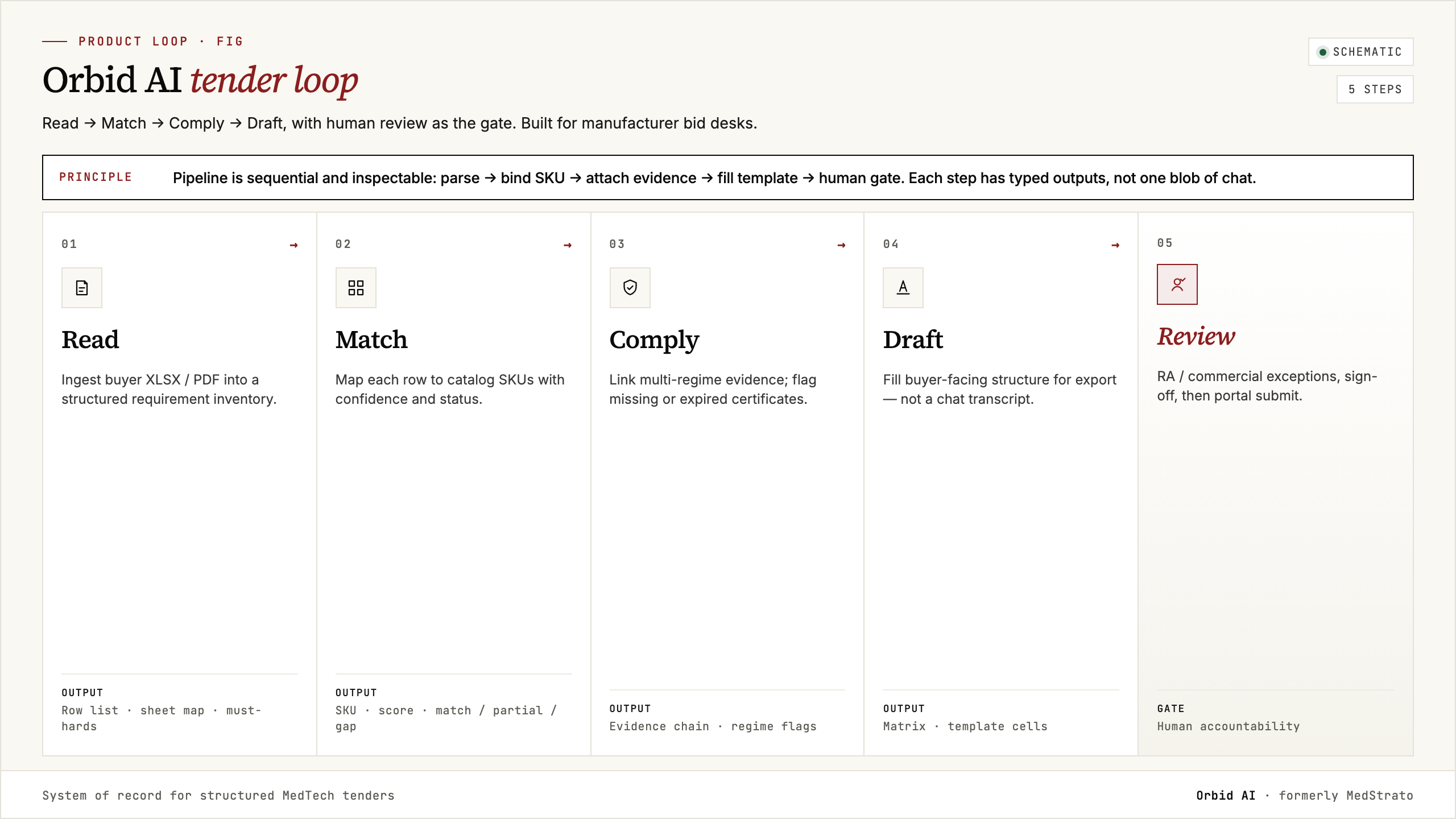
Lire → Match → Conformité → Rédiger, avec revue humaine comme porte. Note de marque : Orbid AI est anciennement MedStrato.
Ce que nous optimisons :
- Appels d'offres MedTech structurés avec tables de spécifications denses
- Match piloté par le catalogue avec états de revue
- Liaison de preuves multi-régimes (lorsque vos données sont chargées)
- Export orienté modèle acheteur pour brouillons prêts pour la RA
Ce que nous ne revendiquons pas sur cette page :
- Des scores de précision ou de vitesse audités par un tiers indépendant pour votre portefeuille
- Que l'usage d'Orbid supprime le risque réglementaire ou remplace le jugement RA/QA
- Que la stratégie de pricing, les conditions commerciales, l'historique relationnel ou les critères d'évaluation narratifs deviennent sans importance
- Que chaque format d'appel d'offres, langue et portail soit aussi fluide dès le premier jour
Coûts et frictions à anticiper :
- Onboarding catalogue et certificats — masters sales, variantes et packs multi-régimes prennent du temps calendaire ; certaines équipes ont besoin de semaines de préparation
- Maintenance continue — nouveaux SKU, rotations d'expiration, changements d'étiquetage
- Sensibilité des données — fichiers techniques complets et certificats dans un système éditeur est une décision de sécurité et d'achats, pas un défaut gratuit
- Lock-in éditeur et sortie — demandez comment exports, propriété des données et double run fonctionnent avant de dépendre d'un seul chemin
- Cas limites — scans médiocres, langage « équivalent à » ambigu, lignes purement commerciales, scoring narratif, portails acheteur inhabituels, règles locales de marchés émergents
- TCO — le prix de siège/usage n'est qu'une partie du coût ; incluez le changement de processus et le double run de votre ancien chemin pendant le pilote
Exemples de friction terrain (non exhaustifs)
Voici le type de situations qui exigent encore un jugement humain.
- Langage d'équivalence ambigu — Quand un acheteur écrit « compatible avec la flotte Model X existante » sans plages numériques ni normes, la confiance de liaison baisse et la ligne est marquée partial. Le jugement commercial/RA reste requis — nous n'acceptons pas automatiquement les revendications d'équivalence.
- Catalogues sales ou multi-noms — Si le même SKU apparaît sous trois noms commerciaux différents selon les marchés, la qualité du matching dépend fortement du nettoyage réalisé avant ou pendant le pilote. Nous faisons remonter l'ambiguïté ; nous ne résolvons pas magiquement une master data non gouvernée.
- Critères d'évaluation narratifs — Des clauses du type « le fournisseur doit démontrer un leadership clinique » ou l'historique relationnel sortent de la boucle matrice. Cela reste assisté par LLM + écrit par l'humain.
Le make-or-buy est ouvert : des équipes capables peuvent assembler Document AI + base de données + agents LLM + jobs d'export. Orbid est un pari packagé pour les desks qui veulent cette boucle sans porter tout le backlog logiciel. Comparez-nous aussi aux autres logiciels d'appels d'offres / RFP, pas seulement à une fenêtre de chat nue. Les bibliothèques de contenu RFP générales (par exemple outils de type Loopio) excellent sur la Q&R narrative réutilisable ; nous nous concentrons davantage sur les liaisons catalogue MedTech et les objets de preuve réglementaires pour des dossiers lourds en spécifications. Métiers différents — parfois les deux cohabitent sur le même desk.
Comment évaluer équitablement (utilisez notre idée de bake-off contre nous)
Nous proposons une méthode. Nous ne livrons pas de résultats audités pour vos données sur cette page.
- Choisissez un appel d'offres de 100+ lignes que vous avez déjà mené (gagné ou perdu).
- Gélez le même échantillon de catalogue et la même échéance.
- Exécutez votre meilleur chemin actuel (Excel, hybride LLM, autre logiciel — ce que vous utilisez réellement).
- Exécutez Orbid (ou toute alternative) sur les mêmes entrées.
- Notez avec la liste de focus ci-dessous — adaptez les poids à votre processus.
Focus de scoring suggéré (adaptez les poids à votre processus)
- Revendications non étayées ou faiblement prouvées
- Certificats manquants / expirés au regard des régimes dont vous avez réellement besoin
- Casse de colonnes du modèle ou effort de reconstruction forcée
- Temps calendaire jusqu'au premier brouillon prêt pour la RA
- Volume de reprise après le premier passage RA
- Heures passées à préparer / nettoyer catalogue + données certificats (comptez-les entièrement)
Si votre hybride Kimi gagne déjà sur ces métriques, gardez-le. Si Orbid ne gagne qu'après un nettoyage de données héroïque, comptez ce nettoyage comme un coût.
Nous sommes heureux de traiter votre dossier en live en démo et de parcourir ensemble la file partial/gap. Préférez l'offline d'abord ? Utilisez notre modèle gratuit : feuille de scoring imprimable · téléchargement CSV.
Quand Kimi d'abord (ou hybride LLM d'abord) est rationnel
- Le travail est surtout narratif, formation ou analyse interne
- Spécifications et certificats vivent déjà dans un système d'enregistrement de confiance
- Vous avez la capacité d'ingénierie pour maintenir bind + preuves + export vous-mêmes (Kimi comme assistant dans ce stack)
- Le volume d'appels d'offres ou la complexité du portefeuille ne justifie pas un autre éditeur
- Votre principale douleur est la lecture de très longs packs, et specs/certificats vivent déjà dans un système d'enregistrement de confiance
Quand un système d'appels d'offres dédié (y compris Orbid) est rationnel
- Les adjudications reposent sur de grandes matrices de spécifications et des preuves multi-régimes
- La fidélité au modèle et les files de revue partagées sont une douleur chronique
- Vous voulez un workflow packagé orienté MedTech plutôt que d'assembler chaque couche en interne
- Vous acceptez l'onboarding et la due diligence éditeur comme partie du deal
Utiliser les deux est souvent la réponse mature
Gardez Kimi pour le langage, l'orientation de longs packs, l'exploration et l'aide à la rédaction. Gardez un système d'enregistrement — Orbid ou le vôtre — pour les liaisons catalogue, les preuves et l'export. Les humains gardent stratégie et signature. Ce n'est pas de l'hésitation ; c'est apparier les outils aux métiers sans prétendre qu'un chat ou workspace est un système d'offre réglementé.
Définition de la boucle d'automatisation : Automatisation de la réponse aux appels d'offres MedTech. Plan de mise en œuvre : guide. Pages éditeur sœurs : vs ChatGPT · vs Claude · vs Doubao.
Envie de tester la différence sous pression sur vos propres fichiers ?
Réserver une démo — nous traiterons un vrai appel d'offres avec vous et passerons en revue la file match / partial / gap ensemble. Traitez chaque affirmation de cette page (y compris les nôtres) comme une hypothèse jusqu'à ce qu'elle survive à vos données.
Fonctionnalités · tarifs · essayez le produit sur orbid.dev · vue d'ensemble du stack : LLM généraux vs agents d'appels d'offres.