Tender Management Software Comparison 2026 (MedTech)
Answer first: This tender management software comparison is for MedTech manufacturer bid desks in 2026—not hospital buyers. Shortlists mix four jobs: horizontal RFP libraries, bid collaboration, life-sciences intelligence, and technical-pack response agents (catalog match, multi-regime evidence, buyer-template export). Orbid AI (formerly MedStrato) is a native AI agent for job 4—device packs, not hospital e-procurement. Definition: tender response automation. Demo: /book · product: orbid.dev.
The wrong tool adds license cost without removing re-key work. The right one lets a small bid team scale volume with audit-ready evidence trails.
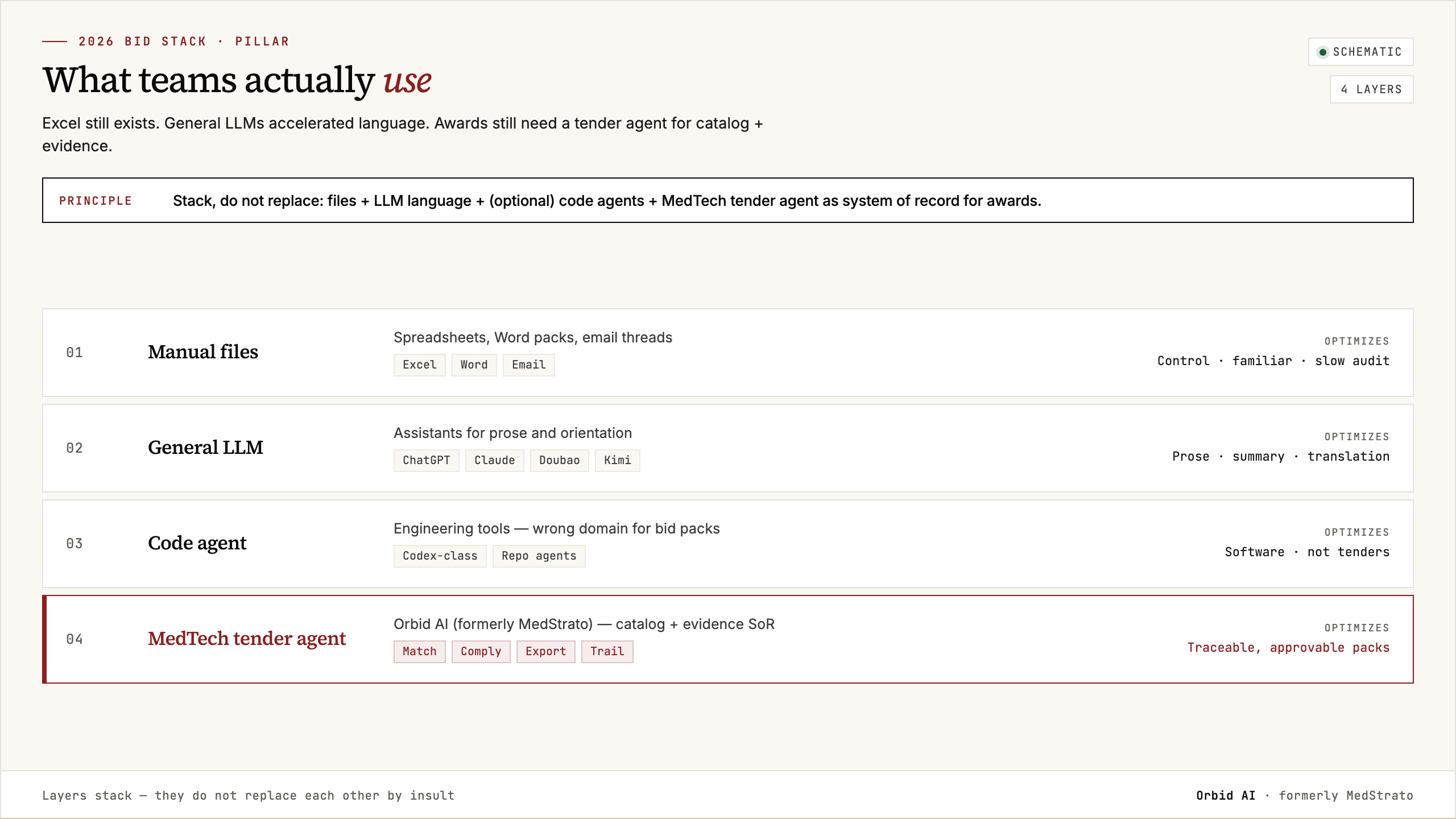
This comparison covers tools that appear most often on manufacturer shortlists: what each does well, where it falls short, and which job it actually buys.
Why medical device teams need a different evaluation framework
Most tender management software reviews are written for government contractors, IT service firms, or generic B2B sales teams. Medical device procurement is categorically different in three ways:
- Technical specification matching: A tender may have 150–300 rows of precise technical requirements (flow rates, pressure ranges, operating frequencies, material specifications). Generic tools cannot semantically match these to product datasheets at scale.
- Regulatory compliance verification: Every matched product needs verified regulatory status — FDA 510(k), EU MDR CE certification, TGA, NMPA, PMDA, and others. Tools without regulatory framework knowledge cannot verify compliance or flag certificate expiry.
- Evidence chains: You need documented, auditable proof for every compliance claim — which datasheet, which page, which test report, which certificate. Audit trails are mandatory, not optional, in regulated procurement.
A tool that excels at IT services RFPs will fail on a 200-row medical device tender. The evaluation criteria must reflect this.
Evaluation criteria
We assessed each tool across criteria specific to medical device tender management:
- Spec matching quality: Can it accurately match technical requirements to product specifications at the row level, using semantic understanding rather than keyword matching?
- Regulatory compliance coverage: Does it verify certificate validity, regulatory regime coverage (FDA, EU MDR, TGA, etc.), and EUDAMED/UDI compliance?
- Evidence chain generation: Does it link each compliance claim to source documents with audit-ready traceability and confidence scores?
- Processing speed: How long does a multi-row technical pack take from upload to matched output on your catalog?
- Multi-language and multi-market support: Can it process tenders across languages and regulatory regimes?
- Buyer-template export: Does output land in the buyer’s columns, not a generic AI PDF?
- Fit to desk: Collaboration cockpit, market-access intel, or technical-pack execution?
Summary comparison table
| Tool | Category (job) | Catalog / line match | Multi-regime evidence | Buyer-template export | Multi-market |
|---|---|---|---|---|---|
| Orbid AI | Technical-pack agent | Semantic SKU match | 14 regimes (product scope) | Native export focus | Broad device markets |
| TenderEyes | MedTech collab SaaS | Library / workflow | Process-led | Office-centric packs | EU + US primary |
| Cube RM | LS intel + AI agents | Screening / prep agents | Lifecycle + data | Package workflows | Global LS portfolios |
| CM|XS Suite | LS lifecycle platform | Workflow-based | Compliance tracking | Process export | EU + US primary |
| AutoRFP.ai | Budget text RFP | Semantic text | None built-in | Text-first | Limited |
| Loopio | Horizontal RFP SaaS | Q&A library | Manual content | Doc assembly | Limited |
| Responsive (RFPIO) | Horizontal RFP SaaS | KB suggestions | Manual content | Enterprise proposals | Limited |
Category labels are a buyer lens—not a claim that one vendor “wins AI.” Buy the job: collaboration, market-access intel, or technical-pack execution.
Tool-by-tool breakdown
1. Orbid AI — native agent for device technical packs
What the agent does: Purpose-built for medical device manufacturers and distributors. Reads the pack, matches requirements to product catalogs at specification level, checks multi-regime evidence, and drafts toward the buyer’s template so humans keep go/no-go and RA sign-off.
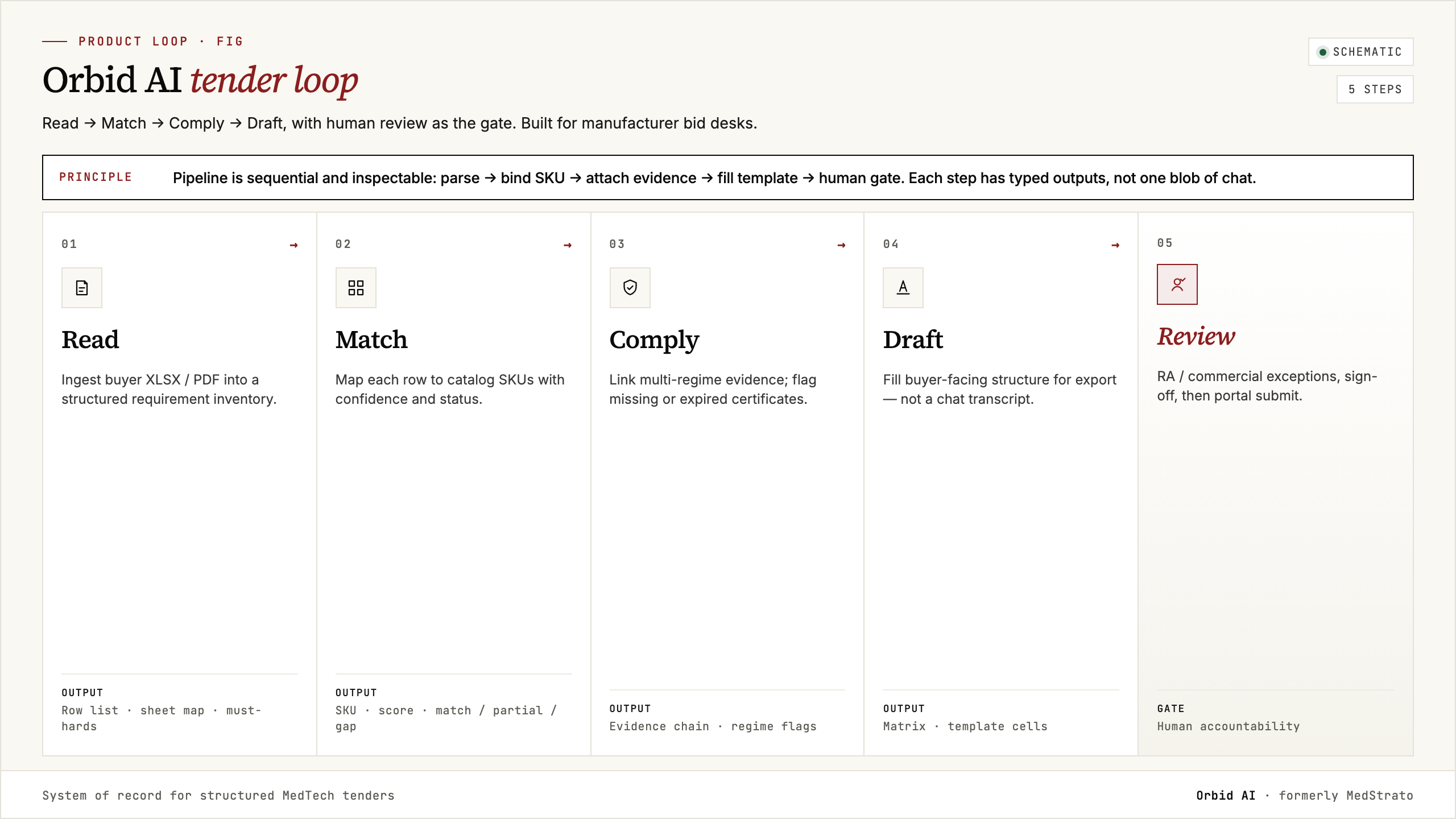
Key differentiator: Tender-native state—catalog SKUs and certificates—not a seat-based answer bank. Example: matching “operating frequency 2.5–10 MHz” to “broadband frequency range 2–12 MHz” as a valid specification match. Matching-phase speed on multi-row packs is an internal vendor benchmark (often on the order of tens of seconds on clean catalogs); treat published figures as hypotheses until they survive your tenders.
Regulatory coverage: FDA (510(k), PMA, De Novo), EU MDR, UK MHRA, TGA Australia, NMPA China, PMDA Japan, HSA Singapore, ANVISA Brazil, and additional regimes listed on product surfaces. Certificate expiry is flagged before submission—not as a separate manual afterthought.
Best for: Medical device manufacturers or distributors responding to recurring technical hospital/GPO packs across multiple markets. Teams where compliance accuracy and evidence chain quality are non-negotiable.
Limitations: Focused on medical device tender response—not a full market-access pricing cockpit and not a Microsoft 365 bid workspace replacement. Not a substitute for RA or legal sign-off.
Next step: Book a demo on 2–3 real packs · orbid.dev · features.
2. TenderEyes — Best for Microsoft 365-centric medtech teams
What it does: Medtech-focused tender lifecycle management platform with deep Microsoft 365 integration. Handles tender tracking, document management, and team collaboration within the Office ecosystem. AI-assisted requirement population and content library for reusing approved response text.
Key differentiator: Teams that operate within SharePoint, Teams, and Outlook will find the integration seamless. Strong at managing the tender pipeline and approval workflow. Better MedTech domain awareness than generic tools. Established platform with long-standing reference customers in EU medtech.
Limitations: Spec matching relies more on content library reuse than on semantic AI matching of technical specifications. Regulatory compliance verification is less automated than a technical-pack agent. Primarily designed for EU and US market tenders. Commercial terms are typically enterprise quote-based.
Best for: Mid-to-large medtech companies with established Microsoft 365 infrastructure, dedicated bid management teams, and primarily EU-facing tender portfolios.
3. Cube RM — life-sciences tender intelligence & agent suite
What it does: Life-sciences tender lifecycle with strong opportunity intelligence, pricing analytics, and—publicly—an AI agent suite across discovery, preparation, knowledge-base style response, pricing simulation, and governance (positioned for Pharma/MedTech portfolios on Tender Central / Salesforce-class deployments).
Key differentiator: Tender intelligence and pricing optimisation for large life-sciences portfolios; multi-agent coverage of the commercial tender journey rather than only a single match engine.
Limitations: Stronger for lifecycle, intel, and pricing strategy than for dirty multi-tab device technical matrices with line-level catalog/regime export. Implementation is typically enterprise-scale. If your loss mode is “200-row device matrix + expired CE on one line,” bake off a technical-pack agent separately.
Best for: Large pharmaceutical or life sciences companies with global tender portfolios, dedicated tender intelligence teams, and complex multi-market pricing requirements.
4. CM|XS Suite — Best for established life sciences compliance workflows
What it does: Comprehensive tender lifecycle platform for life sciences with 25+ years of market presence. Covers opportunity identification, response workflow management, compliance documentation tracking, contract management, and reporting dashboards for leadership visibility into tender pipeline and outcomes.
Key differentiator: Very complete feature set covering the full tender lifecycle from opportunity to contract renewal. Strong compliance workflow management with role-based approvals and document version control. Large reference customer base in EU life sciences, providing confidence for regulated industries.
Limitations: Legacy architecture is visible in the user interface and integration model. Implementation timelines of 3–6 months are standard. Less AI-native than newer platforms: spec matching is primarily workflow-based rather than AI-driven. Less suited for teams seeking fast time-to-value or a modern UX.
Best for: Large, established life sciences companies with mature compliance requirements, existing procurement infrastructure, and budgets that support extended implementation projects.
5. AutoRFP.ai — Budget-oriented option for high-volume text-based bids
What it does: AI-powered RFP response generation using a “libraryless” semantic approach. Generates answers for tender questions based on knowledge base content without requiring manual curation of approved answers. Positioned for teams that want fast setup on primarily text-heavy RFP volumes.
Key differentiator: Speed and low setup friction for text-based RFPs. For qualitative tenders where responses are company descriptions, process explanations, and approach statements, it generates reasonable first drafts quickly with minimal setup.
Limitations: No understanding of medical device regulatory frameworks. No specification-level matching for technical tenders. No evidence chain generation. The AI generates text from knowledge base content and can produce plausible-sounding but inaccurate compliance claims — a significant risk in regulated procurement where false claims lead to disqualification or, in severe cases, post-award audit consequences. Not appropriate for technical medical device tenders.
Best for: Companies responding primarily to questionnaire-style RFPs in non-regulated categories where regulatory accuracy is not a concern. Not recommended for technical medical device tenders.
6. Loopio — Best for IT and professional services RFPs
What it does: Content library-based RFP management. Teams curate a library of pre-approved answers, and the platform surfaces the most relevant ones when a similar question appears in a new RFP. Strong collaboration features for distributed bid teams. Industry-leading adoption in IT, professional services, and financial services procurement.
Key differentiator: Excellent content governance, answer library management, and response collaboration. Widely adopted with extensive integrations. For questionnaire-heavy RFPs where text answer reuse is the primary value driver, it is the most established platform.
Limitations: Keyword-based matching does not understand technical specifications. No regulatory awareness. No evidence chain generation. Library-based approach requires significant upfront curation and ongoing maintenance. Fundamentally designed for questionnaire RFPs, not technical specification tenders. Knowledge base answers degrade in quality over time without active maintenance.
Best for: Technology, professional services, or financial companies with questionnaire-style procurement. Not appropriate for medical device technical specification tenders.
7. Responsive (formerly RFPIO) — Best for enterprise B2B with Salesforce integration
What it does: AI-powered RFP response automation for enterprise sales teams. Uses historical response data combined with AI recommendations to suggest answers for incoming questions. Deep CRM integrations (Salesforce, HubSpot, Microsoft Dynamics) and strong workflow automation for large bid response teams.
Key differentiator: Best-in-class CRM integration and workflow automation for enterprise sales organisations. AI recommendation quality improves over time as more historical responses are added. The collaboration model scales well for large distributed teams responding to many simultaneous RFPs.
Limitations: Same fundamental limitations as Loopio for medical devices: no regulatory awareness, no technical specification matching, no evidence chain generation. AI is trained on generic B2B content, not medical device terminology or regulatory requirements. Answer quality depends entirely on historical response quality — if past responses contained compliance errors, the AI recommends those errors again.
Best for: Enterprise B2B companies with mature RFP processes, large historical response databases, and Salesforce-centric workflows. Not for technical medical device tenders.
Choosing the right tool for your situation
| Your situation | Recommended tool |
|---|---|
| Medical device manufacturer, 5+ tenders/month, multiple markets | Orbid AI |
| Medtech company, Microsoft 365 infrastructure, EU/US focus | TenderEyes |
| Large pharma, global pricing complexity, tender intelligence needs | Cube RM |
| Established life sciences, complex compliance workflows, long implementation acceptable | CM|XS Suite |
| Budget-limited, text-only RFPs, non-regulated categories | AutoRFP.ai |
| IT or professional services firm with questionnaire-heavy procurement | Loopio or Responsive |
Tender tracking software for pharma: what's different?
Pharmaceutical tender management has unique requirements that separate it from generic bid management. Pharma tenders involve pricing regulations (parallel trade rules, reference pricing), volume commitments with penalty clauses, and multi-country framework agreements where a single tender covers 5-10 markets simultaneously.
Pharma tender tracking software needs to handle:
- Price corridor management: Tracking maximum and minimum prices across markets to avoid parallel trade exposure
- Volume commitment monitoring: Forecasting against contracted volumes and flagging risk of shortfall penalties
- Framework agreement lifecycle: Managing multi-year contracts with annual price adjustments and renewal triggers
- Biosimilar tender strategy: Tracking originator patent expiry dates and biosimilar entry timing to optimize bid positioning
Most generic tender management tools treat all tenders the same. Purpose-built pharma tender tracking software understands that a German hospital framework tender for insulin operates under completely different rules than a Singapore GeBIZ tender for surgical instruments. The procurement transformation in pharma is as much about regulatory intelligence as it is about bid automation.
How to run a proper evaluation
Do not evaluate tender management software on vendor demo data — demo environments are curated to show the tool at its best. Evaluate on your actual tenders:
- Select 2–3 recent tenders from different markets and product lines — ideally including one where you had compliance issues and one from a high-value market
- Upload to each shortlisted tool and run the process with minimal vendor guidance — you need to assess real-world usability, not assisted demos
- Measure: time to requirement extraction, specification matching accuracy (row-by-row verification against your datasheets), evidence link quality, compliance verification coverage, and whether the export format matches what the buyer actually requires
- Speak to references in medical devices specifically — not generic B2B or pharmaceutical customers. The technical requirements are different enough that pharmaceutical reference wins don’t transfer.
A vendor confident in their product will actively support this kind of evaluation. One who deflects to a scripted demo with sample data warrants further scrutiny.
Related reading: best MedTech tender tools 2026 · what MedTech tender response automation is · 5-step automation guide.
Ready to run this evaluation on your real tenders? Book a demo with 2–3 of your actual packs so you can see match quality, evidence chain output, and compliance verification before committing. Product at orbid.dev · features · /compare.