A Chinese manufacturer finalizes a distribution agreement for Thailand. Governing law is agreed, delivery dates are fixed, and the counterparty is pressing for signature. Three questions remain unanswered: does Thai law create a post-termination goodwill indemnity, does the arrangement create a dependent-agent tax presence, and who carries professional responsibility if the drafting is wrong? A deterministic cross-border legal workbench is built to answer those questions before money moves, with every fact traceable and every fee fixed.
Orbid is an AI-native law firm focused on cross-border business. Orbid structures a Matter Pack, licensed local counsel admitted in the destination jurisdiction confirm the fixed price and carry professional responsibility, and artificial intelligence never supplies legal advice or substitutes for that judgment. Initial scoping costs nothing and submitting intake materials does not create an attorney-client relationship before Matter Pack approval.
Key Takeaways
- A deterministic workbench means the same inputs, statutes, and review steps produce the same documented output, not a different answer on each re-run.
- Orbid turns a deal summary into a Matter Pack of bounded fixed-fee modules, priced before paid work begins.
- Licensed local counsel confirm conflicts and fees, review the agreed documents, and exercise independent judgment in the destination jurisdiction.
- Facts stay separated by origin, unknowns stay visible as written gaps, and delivery ends with byte-integrity verification and explicit lawyer sign-off.
How the Matter Pack and Fixed-Fee Mechanism Work in Practice
A Matter Pack is the core deliverable. Before any fee starts, Orbid converts a cross-border deal summary and uploaded drafts into a structured set of fixed-fee modules: for example, a contract map, an NDA draft, a distribution draft, a joint-venture scope, or a local-counsel review. A fixed-fee module never exists on its own; it is always a bounded, individually priced unit inside the Matter Pack. Open factual gaps, such as a missing corporate name, unconfirmed shareholding, or an undecided governing law, are recorded as visible written gaps rather than guessed. The confirmed modules and price-change triggers are then approved by licensed local counsel, and only then does paid work begin. Initial scoping costs nothing. For an overarching structural review of portfolio engagements, see our cross-border contract management guide.
The language posture is deliberately three-layered. Client input arrives in its original language. Machine-assisted extraction renders a working translation under the explicit label "Translation: not the original." Counsel review proceeds against the agreement, with clause-anchored findings tied to exact document coordinates and statutory citations. On the review screen, high-risk findings that remain open lock the completion control, so a matter cannot be marked finished over an unresolved risk.
Statutory checking is where the workbench earns its name. In the Thailand corridor, the commercial reality is that the Civil and Commercial Code contains no statutory commercial-agent or distributor post-termination goodwill indemnity, unlike the German model under HGB Section 89b. The operative boundary is instead the agency provisions of the Civil and Commercial Code, including ostensible authority and damages for untimely revocation, alongside the Revenue Code provision governing dependent-agent permanent establishment risk, set against genuine buy-resell distribution. In addition, cross-border commercial relationships must account for foreign ownership restrictions under the Foreign Business Act B.E. 2542, registered license recording requirements under Trademark Act B.E. 2534 Section 68, strict liability under Product Liability Act B.E. 2551, and dispute mechanics under THAC or SIAC arbitration rules.
Germany runs the other way: HGB Section 89b goodwill compensation is live, standard business terms face strict judicial scrutiny under BGB Section 307, anti-money-laundering identity checks follow GwG Section 3, and professional confidentiality follows BRAO Section 43a. Cross-border transfers of personal data rely on GDPR and EU 2021/914 standard contractual clauses. Orbid maintains live corridors for Thailand and Germany; Singapore, Vietnam, Malaysia, Indonesia, the Philippines, and the United States are listed destinations open for scoping enquiries, with local counsel confirmed per matter rather than assumed in advance. You can examine corridor operations on the Thailand and Germany pages, review drafting modules on contracts, inspect the client journey on how it works, and evaluate pricing controls on pricing.

Open Hourly Retainers and Generic Templates vs. the Orbid Matter Pack
The comparison that matters to a General Counsel is not speed. It is who owns the risk, who can reprice, and whether the final document is enforceable where it will actually be used. For practical guidance on scoping without budget overruns, review how to scope APAC cross-border contracts without hourly surprises as well as our Matter Pack quickstart checklist.
| Dimension | Open-Ended Hourly Retainers | Unreviewed AI or Generic Templates | Orbid Fixed-Fee Matter Pack |
|---|---|---|---|
| Price certainty | Accrues by the hour; final cost unknown at signature | Free or low cost, with unbounded downstream risk | Bounded fixed-fee modules confirmed before paid work starts |
| Scope control | Additions absorbed into the running bill | No scope boundary at all | Mid-deal additions require a written change order; approved scope continues on schedule |
| Destination-law enforceability | Depends on the drafting lawyer's corridor familiarity | Unverified, frequently untethered from local statute | Licensed local counsel confirms the review in the destination jurisdiction |
| Fact provenance | Lives in email and memory | None; facts appear without origin | Three-tier ledger separating client input, extracted facts, and lawyer-confirmed facts, with written gaps preserved |
| Version governance | Attachments multiply without a single source | No version control | One designated current client-facing contract plus SHA-256 byte-integrity verification |
| Professional responsibility | Firm of record, scope sometimes implicit | Unallocated | Licensed local counsel carry professional responsibility; AI does not |
The neighbour-file problem deserves attention. In a conventional retainer, drafts circulate by email until nobody can say which version the client saw. Orbid isolates lawyer-only working drafts so they remain private until explicitly released, and delivery requires an explicit lawyer release action rather than an automatic send. File hashes confirm the bytes did not change after sign-off; they are an integrity control, not a statutory electronic signature such as an eIDAS qualified signature.
Workflow Controls, Statutory Checkpoints, and a Preparation Checklist
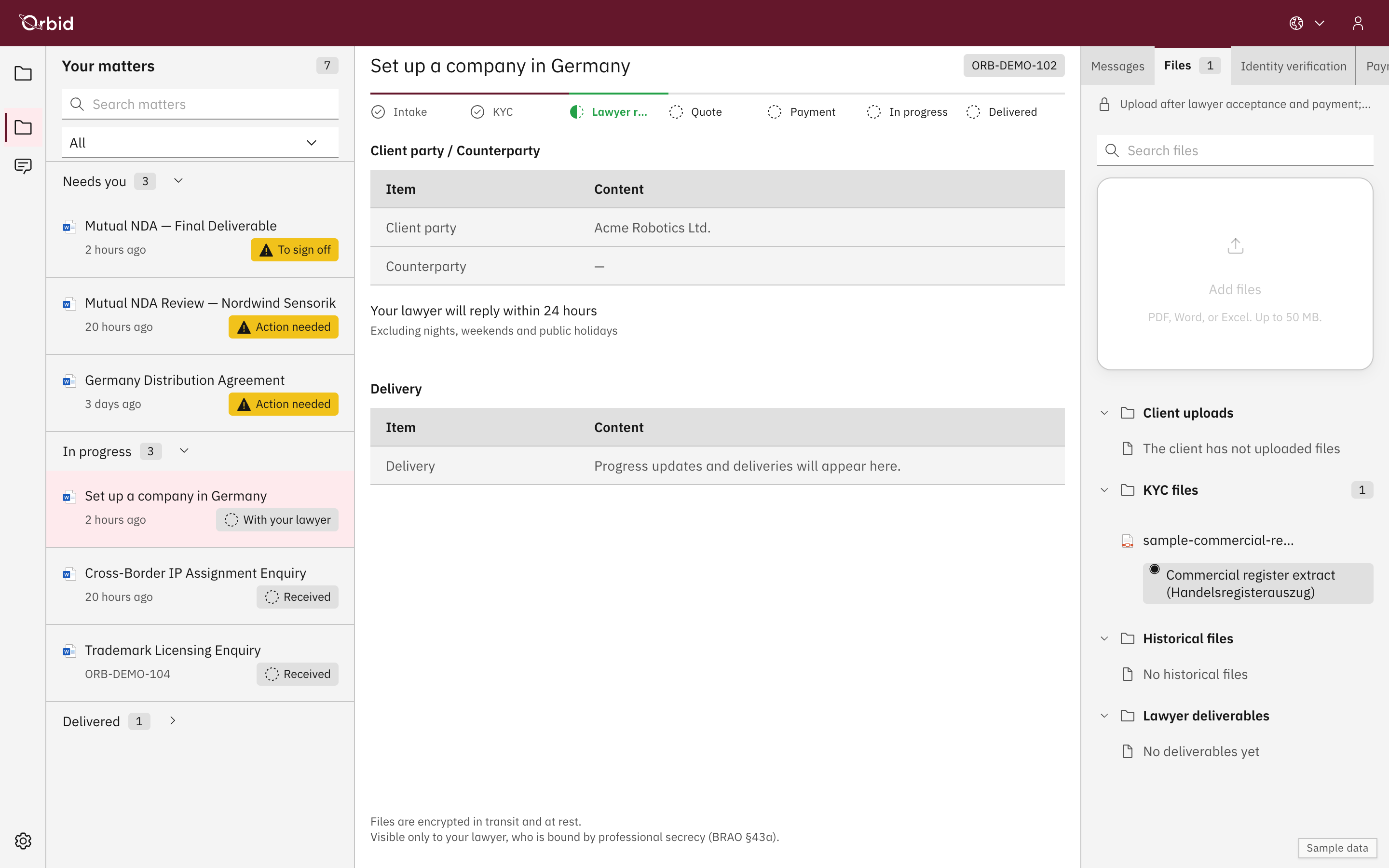
The matter lifecycle runs in a fixed sequence: intake, KYC, lawyer review, quote, payment, work in progress, and delivery. Formal acceptance of the engagement follows server-verified payment confirmation, which keeps the fee boundary honest in both directions: no billing before approval, no work before payment clears. Separately, counsel work inside a matter proceeds across parallel operating tabs for files, chat, agent-assisted pre-checking, review findings, KYC, facts, and delivery. The lifecycle is the client-facing sequence; the tabbed workbench is counsel's parallel instrument.
Two boundary statements belong here. First, submitting intake or scoping materials costs nothing and does not create an attorney-client relationship until the Matter Pack and the fixed price are approved. Second, when a mid-deal addition appears, such as a new jurisdiction or an unexpected shareholders' agreement, paid work on that addition stays halted until the client approves the written change order, while the original approved scope continues on schedule. Orbid never trains AI models on client files; infrastructure processors operate the service under that constraint.
Preparation checklist for an outbound engagement:
- Assemble the deal summary, both parties' corporate details, and every existing draft in original language.
- Identify the destination jurisdiction and the intended governing law, and flag any dispute-forum preference such as arbitration under THAC or SIAC.
- State known gaps explicitly rather than allowing assumptions to fill them.
- Confirm entity registry records, sanctions lists, and ultimate beneficial ownership information for the counterparty.
- Name the internal corporate decision-maker authorized to approve a written change order if scope shifts.
Next Step: Lock Scope and Fixed Price Before Work Starts
Your next cross-border matter deserves a defined scope and a confirmed price before the clock starts running, with local counsel on record and every fact traceable to its source. Start with Get my price and review the full architecture at orbid.dev.